

This month’s theme is “Rediscover the Beauty around You”! Lets teach ourselves to feel satisfaction for the small things in life. When we achieve that, we will notice how Life starts loving us back!
Please enjoy the three articles below. They are about Emotional Intelligence; How to learn to Meditate; and some Yoga postures called “Sun Salutations” – they are the most complete mental and physical exercise available, since they include the three major components of balanced fitness: flexibility, strength, and cardiovascular conditioning.
10 Tips for Improving Your Emotional Intelligence

Emotional intelligence (EI) was first referenced way back in 1964 but it didn’t become mainstream until science journalist Daniel Goleman wrote Emotional Intelligence: Why It Can Matter More Than IQ in 1995. It’s a “soft” skill. Human resource professionals look for those with a high EQ and positive psychology research shows that positive social connection is a powerful tool to increase well-being. Although it may seem easier to provide training for the so-called hard skills, improvement to emotional intelligence also happens with practice.
What Is Emotional Intelligence?
“Emotional intelligence is the ability to sense, understand, and effectively apply the power and acumen of emotions as a source of human energy, information, connection, and influence.” – Robert K. Cooper, leadership expert, with an emotional intelligence definition
Emotional intelligence refers to your ability to recognize what emotion you are feeling and to manage that emotion in a way that allows you to use the emotion rather than becoming overwhelmed by it. It also includes your ability to accurately interpret and respond appropriately to the emotions of other people. Understanding the strengths of your own EI and being able to convey these strengths to others will also help you in achieving success in your relationships and your personal goals.
Like any new habit, developing greater emotional intelligence takes conscientious, consistent effort. Below you will find a list of 10 ways to get started.
Get Fluent in the Language of Emotions
It’s fairly common to grow up correctly showing and interpreting the six basic emotions:
- Happiness
- Sadness
- Fear
- Anger
- Surprise
- Disgust
Often, as a child matures, these six are discouraged. Children are taught “big girls don’t cry” or told to “man up,” giving them an implicit idea that suppressing their feelings in various situations is a mature way to behave. The problem with stuffing emotions down is they eventually need to come out; otherwise, they become negative emotions. If not expressed verbally nor given proper attention, they may manifest in physical symptoms or psychological challenges.
Worse than suppression is something psychologists call emotional avoidance; this is where rather than feeling an emotion, it is replaced with an unhealthy habit like binge eating, self-medicating with drugs and alcohol, or even over-exercising. To combat this, practice feeling, then naming your emotions in a nuanced way.
Expand past the six emotions, trying to differentiate anger from disappointment and frustration and joy from happiness and excitement. Languages other than English have many words for a single emotion like love. In Greek, storge is the word for love between family, philia is love for a close friend, eros is romantic love, and agape is the love felt on the level of collective consciousness where the feeling “we are all one” exists within. Aspire to be as clear about your emotions as the Greek are about love.
Put Space Between Stimulus and Response
Part of emotional intelligence is understanding your emotions—search your memory for emotional intelligence examples. It is part of popular culture to believe that something can trigger emotion. A speaker will say, “This may be triggering to some audience members,” before discussing a tragic event. A more empowering way to think of emotions is the way of Viktor Frankl, Austrian neurologist and Holocaust survivor, who made famous the theory that between stimulus and response there is a space that the individual controls—their belief. Emotionally intelligent people know that emotions don’t happen to them, they are a response created by them.
As you start to recognize this, examining why you believe what you believe and where this belief began, you become better equipped to recognize the emotional patterns and reactions that no longer serve you. When stressful situations occur, or a powerful emotion happens, take time after the emotion has subsided to ask yourself why you felt that way. A question to use when you get stuck or feel like you don’t know is, “What do I think would happen if I didn’t feel__________?”
Practice Mindful Reflection
Mindfulness is a wonderful tool for decreasing rumination. In fact, mindfulness, meditation, and emotional intelligence have been regularly linked in scientific literature. Meditation allows you to slow down and stay present in a way that calms your physiology and sets the stage for emotional intelligence. How? Mindfulness has been shown to help you learn how to recognize the emotions of other people around you thereby increasing empathy and improve a person’s ability to use their emotions to regulate stress.
Want to increase your EI? Start a daily practice or start a 21-day meditation with Deepak and Oprah.
How You Talk About Emotional Response Matters
It is common to hear someone ask, “How did that make you feel?” Or you may say, “You make me so mad.” Taking ownership over your emotions begins by speaking about them in a way that doesn’t send yourself a disempowering message; this will help you to become more emotionally savvy. Your thoughts become reality, so put your energy toward speaking about emotions in a way that plants you firmly in the driver’s seat rather than being the passenger just along for the ride.
What Gets Measured Matters
Things like EI can seem abstract or theoretical, but in fact, there are ways to measure. Try taking this EI quizon the Greater Good Science Center website or try the Global Emotional Intelligence Test (GEIT) based on Daniel Goleman’s work.
Flex Your Social Muscle
When you socialize and communicate with others you get to practice reading the emotional signals of others. Put yourself out there. Go to a new book club, introduce yourself to new people at a conference, or go out for a sports team. If you are already quite social but need to learn to read people better, you might try EQ for Success, a card game from Play Therapy Supply. You don’t get fit from one trip to the gym—your EQ (another abbreviation for emotional intelligence) muscle is similar to all your other muscles, it needs regular flexing.
Practice Both Compassion and Self-Compassion
Compassion is kindness, caring, and a willingness to help. Feeling empathy and being able to empathize is your ability to put yourself in someone else’s shoes while compassion is the reaction and action that stems from that experience. Self-compassion, according to researcher Kristin Neff’s work, involves mindfulness instead of over-identification, common humanity versus isolation, and self-kindness instead of self-judgment. It takes EI to see that compassion and self-compassion are strengths of a confident and self-assured person. To develop both traits, focus on assuming good intention where others are concerned, and being kind and patient with yourself.
Manage Stressors and Emotions in Healthy Ways
Life comes with stress. Things go wrong. You fail a test, you crash a car, you forget a birthday, you lose a job, you make a mistake—the list goes on and on. If you spend your time trying to control the waves in the ocean rather than learning to surf them, you will get tired. When people manage stress and emotions poorly they often self-medicate or withdraw socially. Instead, try an affirmation like:
I can accept feedback from others without becoming angry.
I control urges to overindulge.
I maintain my composure, even during stressful times.
Express Yourself
Not all expression is verbal. Paint, dance, sculpt, surf. Think of action like a release valve. Emotions are like shaking a bottle of soda. If you shake a bottle then open it, you get an explosion. But if you let a little air squeeze out occasionally, you can shake it without ever causing an explosion. When you feel something, name it aloud. Notice it. Name it. And then encourage it to stay or move on depending on how it helps you or hinders you. Think of how a little anger can propel you to be more aggressive in a tennis match—under the control of an emotionally intelligent purpose, your emotions can be harnessed to help.
Pastor Joel Olsteen asked, “Are you a thermostat or a thermometer?” It’s a good thing to ask yourself. Are you taking your emotional temperature or are you controlling your emotional temperature? This refers to self-regulation, which is not the same as suppression. By turning your thermostat up and down as needed, you can develop your EI and become less volatile or rigid.
Learn to Meditate in 6 Easy Steps

You’ve heard that meditation and mindfulness can benefit your health and wellbeing, so you’ve decided to give it a try. But you’re not sure where to begin … how do you “quiet the mind?”
The key to learning how to meditate and developing a successful meditation practice is finding the right fit for you. In order to figure out what form of meditation works best for you, you’ll have to put a few types of meditation to the test and try several tools so you can choose the practice that feels the most comfortable. Follow these six simple steps to begin one type of meditation technique called mantra meditation.
Mantra Meditation Technique
- Choose your mantra. A mantra is a word or phrase that you silently repeat to yourself during meditation. The purpose of the mantra is to give you something to put your attention on other than your thoughts. You may use any phrase you like. Some people like to use words like “Peace” or “Love”. You may wish to use the So Hummantra. This is a commonly used Sanskrit mantra, which literally translates to “I am.” It is often referred to as the mantra of manifestation. I like using the So Hummantra because it is not in my native English language and does not trigger any additional thoughts.
- Find a comfortable place to sit. It’s best to find a quiet location where you won’t be disturbed. There is no need to sit cross-legged on the floor unless that is comfortable for you. You can sit on a chair or sofa or on the floor with your back against a wall. You may support yourself with cushions, pillows, or blankets. The goal is to sit as upright as possible while still remaining comfortable. We all have different anatomies and you want your meditation experience to be enjoyable, so make your comfort a priority. Lying on your back is usually not recommended because most people fall asleep in this position, but you can try it if sitting is uncomfortable for you. The most important rule is that meditation can be practiced anywhere, as long as you’re comfortable.
- Gently close your eyes and begin by taking some deep breaths. Try taking a few “cleansing breaths” by inhaling slowly through your nose and then exhaling out your mouth. After a few cleansing breaths, continue breathing at a normal relaxed pace through your nose with your lips gently closed.
- Begin repeating your mantra silently to yourself without moving your tongue or lips. The repetition of your mantra is soft, gentle, and relaxed. There is no need to force it. The mantra does not need to correlate with the breath, though some people prefer to do so. For example, if using So Humas your mantra, you could silently repeat Soon your inhalation and Humon your exhalation. If you choose to correlate your mantra with your breath, do not become overly fixated on this. As your meditation continues, allow the breath to fall away into its own rhythm. The repetition of your mantra should be almost effortless. Sometimes it is helpful to imagine that rather than repeating the mantra to yourself, you are actually listening to it being whispered in your ear.
- Do not try and stop your thoughts or empty your mind.As you continue with this meditative process, you will inevitably find that you drift away from the mantra. It is human nature and normal for the mind to wander. Do not try and stop your thoughts or “empty your mind.” Whenever you become aware that your attention has drifted away from your mantra to thoughts or any other distractions while meditating, simply return to silently repeating the mantra.
- Stop repeating the mantra. After approximately 20 to 30 minutes, you may stop repeating your mantra and continue sitting with your eyes closed. Be sure to spend a few minutes relaxing with your eyes closed before resuming activity. You may use a timer with a very gentle, low-volume sound. Many people use their cell phones as meditation timers. You can download a meditation timer app on your smart phone or choose a soothing sound on your phone’s built-in timer. Be sure to turn the volume down very low as you don’t want to be startled out of your meditation.
If you find that 20 to 30 minutes is too long for you, start with whatever amount of time you can, and slowly build your way to 20 to 30 minutes. Even a few minutes of daily meditation is beneficial.
The benefits of meditation are greatest when practiced daily. Ideally, meditation can be done first thing in the morning upon rising and then again at the end of the day, preferably prior to dinner. I like to start my day feeling centered and balanced after my morning meditation. And I often think of my evening meditation as a “release valve,” allowing any stress or tension from my day to simply drift away.
Celebrating Life through Sun Salutations
By Teresa Long

Our body posture can be an indicator of how we are feeling. We sit with our backs straight when we are alert; we slouch when we are tired, and so on. As we bring awareness into our bodies, we tend to change postures so we can get more comfortable. In turn, as we change postures it results in a spontaneous shift in our awareness. This feedback loop between body awareness and body positioning is part of the practice of yoga.
Yoga can revitalize your mind as well as your body. In general, yoga practice includes two of the major components of balanced fitness: flexibility and strength. If you add Sun Salutations to the mix, you incorporate the third major component of balanced fitness: cardiovascular conditioning.
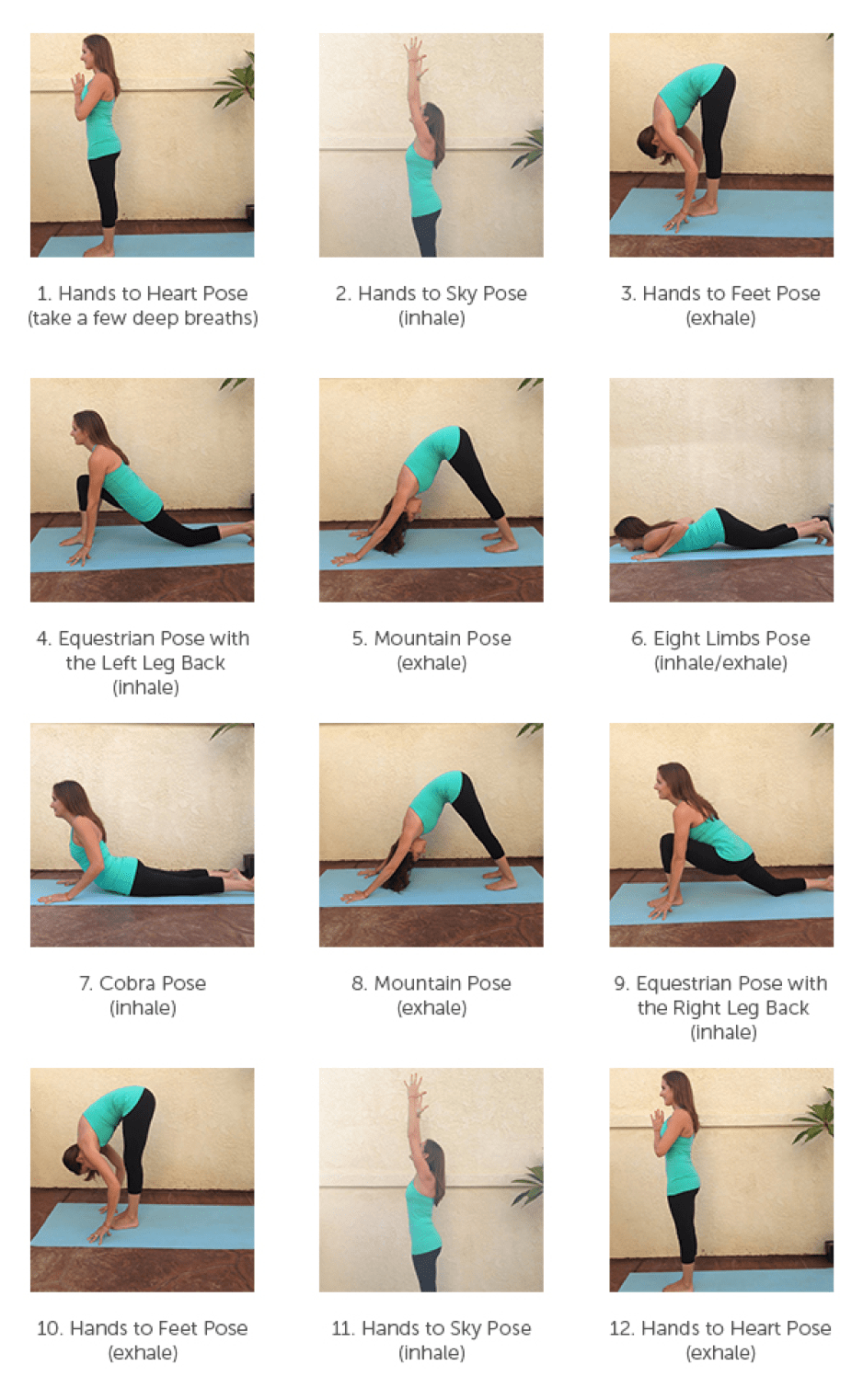
Sun Salutations, known in Sanskrit as Surya Namaskar (pronounced Sir-yah- Namah-skar), are a series of movements that flow with the breath. The movements accompany your breathing to help strengthen the heart, improve circulation, and lengthen and strengthen all major muscles in the body. Sun Salutations have been described as the most complete mental and physical exercise available.
Radiate Your Essential Self
Even if you do not have time to work out on a regular basis, performing Sun Salutations every day will bring vitality and aliveness into your life. The twelve yoga postures included in the Sun Salutation series are designed to awaken the connection between the sun and your agni, or inner fire. As you kindle your inner fire, you can radiate your innate love and happiness out into the world.
As we perform Sun Salutations to celebrate the sun, we also celebrate life in general as well as our inner life and our connection with the universe. We celebrate life because the poses in the Sun Salutation series represent the full experience of life, with all its highs and lows, and beginnings and endings. We celebrate our inner life because we are ultimately beings of light, like the sun, and performing Sun Salutations rejoices in this aspect of our being. We celebrate our connection with the universe because the sun is the source of all life on this planet.
For more information on Sun Salutations, refer to The Seven Spiritual Laws of Yoga book.
To increase your level of energy, nurture your connection with mind-body-spirit, and enhance your liveliness, try the following Sun Salutation yoga sequence.
9 Natural Remedies for an Upset Stomach
No matter what the root cause—a bug, food sensitivity, stomach flu, stress, food allergies, constipation, morning sickness, or something else that’s ailing you—when you have an upset stomach, you want it to stop hurting and fast. Although there’s no silver bullet to soothe a stomachache, there are a handful of foods and natural remedies for an upset stomach that may help.
All nine of these are inexpensive and, chances are, you either keep most of these items stocked in your kitchen, or you can easily employ these techniques as soon as you need them.
- Shoot Apple Cider Vinegar Mixed with Water
Apple cider vinegar (ACV) is one of the great neutralizers. Made by fermenting the sugar from apples, ACV promotes alkalinity, and, in turn, alleviates nausea. It can also reduce gas and bloating, and mitigate heartburn.
Mix a tablespoon of ACV into room-temperature water. If you can’t tolerate the sour flavor, use less water, hold your nose so you can’t taste it, and shoot the mixture back in a few seconds. If you enjoy the flavor, use more water and sip it at your leisure.
- Drink Aloe Vera Juice
Aloe vera juice helps with acid indigestion, heartburn, constipation, and other stomach issues. Unless you’re challenged with the latter, try drinking 2 ounces at a time—up to 8 ounces in a day—and see how your body reacts. Because aloe vera juice is a natural laxative, drinking too much may cause you to go to the bathroom more.
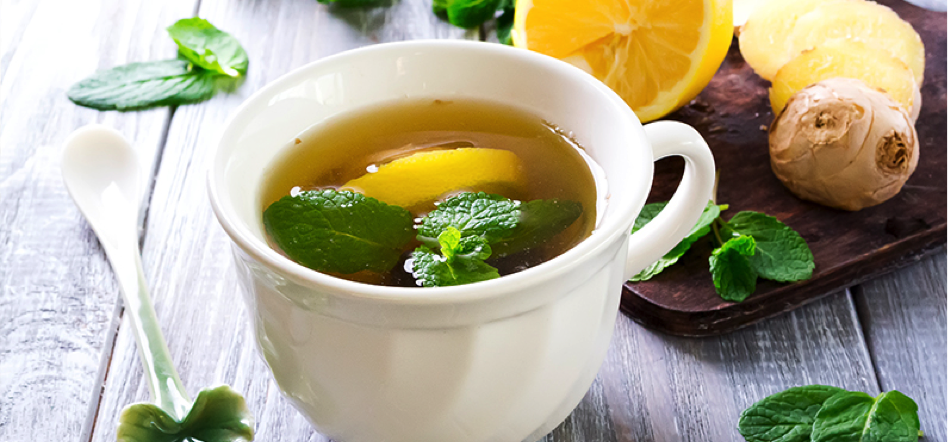
- Sip Ginger or Peppermint Tea
Ginger and peppermint are some of the best foods for upset stomach and can help relieve nausea, morning sickness, and abdominal discomfort. A review of six studies of 500 pregnant women found that ingesting 1 gram of ginger daily was linked with five times less nausea and vomiting during pregnancy. Researchers have found that peppermint relaxes the muscles in the digestive tract and therefore reduces the severity of intestinal muscle spasms that can cause pain and diarrhea, particularly in people with irritable bowel syndrome, which is a chronic gut disorder that can cause stomach pain, bloating, diarrhea, and constipation.
You can add ginger or mint to a variety of recipes, or you can drink it in herbal tea. Purchase premade tea bags and dunk them in hot water. Or, to make homemade tea with fresh herbs, steep a few chunks of ginger root, or a few mint sprigs, in 8 ounces of boiling water for two to five minutes. If you want to unlock additional oils from the herbs while the tea steeps, press them with a muddler, which is a tool that’s used to release flavors.
- Apply Heat or Take a Warm Bath
Applying heat to your stomach or immersing yourself in warm water (also known as hydrotherapy) can increase circulation and relax the muscles to reduce tightness or cramps. Use a warm towel or a microwaveable compress—either store bought or make your own by filling a clean sock or pillowcase with uncooked rice—and microwave it on high for a minute or two. If you’re taking a warm bath, add 1 to 2 cups of Epsom salt to the water and stay in the bath for 15 to 20 minutes to help draw out any inflammation.
- Eat Fennel
Not sure what to eat with an upset stomach? Fennel, a flowering plant species in the carrot family, supports digestion, and reduces gas, bloating, cramping, and nausea from an upset stomach. The vegetable has a sweet anise or licorice flavor. It’s indigenous to the shores of the Mediterranean, but it’s grown around the world and you can find it in most grocery stores. Eat it raw, roast it in the oven, steep it in boiling water to make a tea, or crunch on fennel seeds.
- Be Sure You’re Hydrated
Dehydration impairs digestion, making it more difficult and less effective, which can cause stomach cramping and nausea. Hydration is important for overall health. If you experience an upset stomach during or following exercise, or you have an illness that’s causing you to vomit, it’s especially important to drink more water or beverages that contain electrolytes—sodium, potassium, chloride, calcium, magnesium, and phosphate.
Coconut water, a natural alternative to manmade electrolyte drinks, is high in potassium, and also contains sodium, magnesium, phosphorus, and vitamin C. You can also make your own rehydration drink at home by adding 1 teaspoon of sea salt and 4 teaspoons of organic cane sugar to 1 liter of water. Sea salt is rich in electrolytes and trace minerals, and sugar is a simple carbohydrate that helps with quick electrolyte absorption.
Although some say you should drink eight 8-ounce glasses of water per day, there really isn’t a one-size-fits-all rule when it comes to hydration. People who are more active may need to drink more. People with thyroid disease or kidney, liver, or heart problems may need to drink less. It’s important to work with your health care practitioner to understand how much water you need each day.
- Massage Your Stomach While Taking Deep Breaths
Muscle constriction and constipation may cause stomach cramps. Gently massaging your abdomen can increase circulation and encourage elimination. While massaging, focus on the parts of your stomach that feel sore, and take care to not push or rub too hard. Breathe in through your nose and out through your mouth to help relax your muscles and guide your mind away from the pain. A studypublished in the American Journal of Gastroenterology revealed that deep breathing can alleviate acid reflux.
- Drink Baking Soda in Water
The primary ingredient in many over-the-counter antacids is sodium bicarbonate, which is more commonly known as baking soda. If you have indigestion or feel nauseated, it’s easy and inexpensive to make your own antacid remedy at home to neutralize pH balance in the body. Simply stir 1/2 teaspoon of baking soda into 4 ounces of warm water, and slowly drink the solution as a natural remedy for an upset stomach.
- Practice Stress-Reduction Techniques
The biochemical and hormonal changes that result from emotional stress can negatively impact digestive health. When you’re under mild, anxiety-induced stress, you might report feeling like you have a “pit in your gut” or “butterflies in your stomach.” With more severe stress, you might experience indigestion, constipation, bloating, gas, diarrhea, nausea, and vomiting. Chronic stress may contribute to the onset or worsening of more severe digestive issues, such as inflammatory bowel diseases like Crohn’s disease and ulcerative colitis, gastroesophageal reflux disease, irritable bowel syndrome, and stomach ulcers.
To help relieve or even prevent stomach challenges, do your best to manage stress through whatever stress-reduction technique works best for you—exercising, stretching, meditating, spending time outdoors, doing something creative, or breathing deeply.
Next time you need upset stomach relief, try one or several of these natural home remedies to soothe your digestive tract and alleviate the pain. If the pain persists, visit your health care practitioner so they can help determine if other stomachache remedies are needed to get you back to feeling your best.
 Healing through Art