
Hello everyone, it’s your host Sevina. Happy summer! Time for vacations and getting the family together. The articles below will show you some mindful practices you can adopt so you may improve your health and the quality of communication with your kids and relatives.
Namaste!
Mindful Eating
By Sevina Altanova
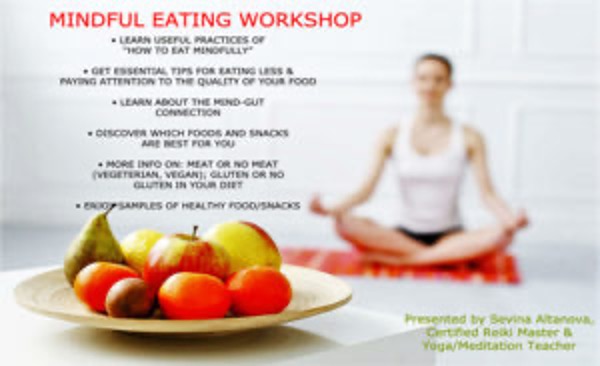
We are what we’re eating! Yes, it is that simple. The food we consume is the fuel for our bodies. The way we perform depends on the fuel we are putting inside of us.
“Mindful Eating”
it’s based on the Buddhist concept of Mindfulness, which involves being fully aware of what is happening within and around you at the moment. Mindfulness techniques have also been offered to relieve stress and alleviate problems like high blood pressure and chronic gastrointestinal difficulties.
Mindfulness is an ancient practice of “being completely aware of what’s happening in the present”—of all that’s going on inside and all that’s happening around you. It means not living your life on “autopilot.” Instead, you live your life “consciously in the present” in order to experience life as it unfolds moment to moment, good and bad, and without judgment or preconceived notions. “Many of us go through our lives without really being present in the moment,” being present in the now is the fundamental aspect of the spiritual practice to life and living.
As you start to learn how to be more mindful, it’s common and normal to realize how much your mind races and focuses on the past and future. You can just notice those thoughts and then return to the present moment. It is these little, regular steps that add up and start to create a more mindful, healthy life.
The simple techniques involved in mindful eating—eating without watching the TV or computer, eating in silence, chewing slowly, taking breaths between bites—can help us focus more on what we are choosing to put into our bodies, and why?
The Mind–Gut connection
Digestion involves a complex series of hormonal signals between the gut and the nervous system, and it seems to take about 20 minutes for the brain to register satiety (fullness). If someone eats too quickly, satiety may occur after overeating instead of putting a stop to it. There’s also reason to believe that eating while we’re distracted by activities like driving or typing may slow down or stop digestion like how the “fight or flight” response does. And if we’re not digesting well, we may be missing out on the full nutritive value of some of the food we’re consuming.
When you eat mindfully, you slow down the process of eating, turn off autopilot, and focus on the present moment. Increasing your awareness of the present moment helps you become more conscious of your food choices and requires you to use all five of your senses. This helps you truly taste and enjoy your food – without stuffing yourself. When you eat mindfully, it also makes you more aware of your body’s cues that tell you how hungry or full you are.
From Stress Management Resources “Mindful Eating Workshops”
*
Other “Stress Management Resources” tools for happier living 🙂
“Anxiety Relieve” Relaxation/Meditation
“Overcoming Panic Attack” Relaxation/Meditation
“Clearing Chakras” Relaxation/Meditation
“Gamma Light/Sound” Relaxation/Meditation
Anxiety Relief Relaxation
Preview:
*
Relaxation for Overcoming a Panic Attack
Preview:
*
Clearing Chakras Relaxation
Preview:
*
Alzheimer’s Disease Therapy with Combination of 40Hz Light and Sound
Preview:
*
Empowering Children Trough Positivity and Connection
By: Mallika Chopra

Teaching meditation, mindfulness practices, and positivity to children is fun and fulfilling. Children bring a sense of wonder and innocence to everyday practices that remind adults of the magic and smiles that come with connection.
As a parent, it is wonderful to guide your children with simple practices throughout the day and watch how they connect with their breath, feelings, body, and environment.
Here are some tips on teaching your kids practices for positivity and connection:
- Teach by example, not just words – role model how simple practices affect you and share your feelings. When you are frustrated, take a deep breath to calm down. Express gratitude throughout the day. Demonstrate ways to be kind. Children are always watching and learning from you.
- Make every interaction fun – bring in humor, laughter, tickles.
- Never force your child to meditate or do a practice. Teach them simple tools and then let them experiment and see what works best. For many children, movement works better than trying to slow down or be still. This is normal, natural, and age-appropriate. (The Just Be Series has dozens of easy practices for children and the adults in their lives.)
- Use positive affirmations and phrases to remind kids that they are strong, creative, and powerful.
In my new children’s book, My Body Is A Rainbow: The Color of My Feelings, I present colors, words, and breath to give children a fun, interactive way to explore their body, mind, and spirit. Here is the simple exercise:
- Sit comfortably and take a deep breath, in and out.
- Feel your bottom and imagine the color red around you.
- Breathe in and out. Say, “I am safe.”
- Put your hand under your belly button and feel orange.
- Breath in and out. Say “I am creative.”
- Put your hand on your stomach and feel yellow.
- Breathe in and out. Say “I am strong.”
- Put your hand on your heart and feel green.
- Breath in and out. Say “I am loved.”
- Put your attention on your neck and throat, and feel light blue.
- Breathe in and out. Say “I am unique.”
- Imagine a dark blue spreading across your face.
- Put your hand between your eyebrows. Breathe in and out. Say, “I am wise.”
- Now imagine purple at the top of your head spreading above you and into the skies.
- Breathe in and out. Say “I am.”
Last but not least, take another breath, in and out.
Feel your favorite colors all over your body.
And, smile!
*
Coconut Cranberry Granola
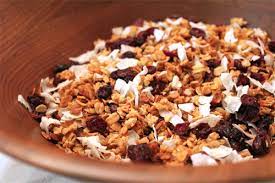
Granola is a classic breakfast staple that you can enjoy any time of day. However, many granolas are loaded with processed grains and sugars that taste good, but don’t leave you feeling good. This Coconut Cranberry Granola is full of wholesome ingredients that are delicious and healthy. It’s sweet and savory, crunchy and chewy, and everything you could possibly want in a granola. It’s grain-free and vegan too.
Ingredients:
- 2 cups unsweetened coconut flakes
- 1/2 cup dried cranberries
- 2 tablespoons melted coconut butter
- 2 tablespoons maple syrup
- 1 teaspoon ground cinnamon
- Pinch of Himalayan pink salt
Directions:
Preheat your oven to 300 degrees F. Line a large baking sheet with parchment paper to prevent the granola from sticking.
Mix all your ingredients together in a medium-sized bowl until everything is incorporated together and coated in coconut butter and maple syrup.
Pour mixture onto the baking sheet with parchment paper and spread out evenly into a flat layer.
Bake the granola for 8 minutes, stir, and then bake again for another 8 minutes. Let the granola cool and it’s ready to eat!
Use this granola over your favorite dairy-free yogurt, eat it as a snack, or use it as a topping for baked fruit.
Serves 8
 Healing through Art